Your jobsite talks all day.
CrewLog writes it down.
Forty seconds of a foreman talking becomes a daily report that holds up in a dispute. A sentence becomes a priced change order. Nothing is saved, sent or signed until you read the card and tap Confirm.
7 days free on Pro, then the plan you pick · Card required, $0 today · Cancel anytime
- Work Completed
- Delays & Disruptions
- Issues & Follow-Up
- Materials & Deliveries
- Site Conditions
- Safety Observations
- Crew & Manpower
- Planned for Next Work Day
Eight sections are defined. It writes only the ones your notes support and leaves the rest out entirely — no “none reported”, no empty headings. Forty seconds of talking earned four.
CrewLog queued 1 follow-up from your notes
Get direction on the north elevation window opening before framing continues
View tasks →The flags and the follow-up are a second read of the same forty seconds, looking only for what a dispute would need and what somebody still has to do. The change-order flag is a link: it opens a new change order with what it found already in it.
Every line in that report traces to something the foreman actually said. The weather is the exception, and it is not a guess either: it is recorded from a weather service and handed over as fact.
It doesn’t answer from a prompt. It answers from the job.
There is no separate AI for reports and another for change orders. One assistant reads the whole record of a job — the logs, the schedule, the RFIs, the change orders, the hours — and answers across all of it in a single turn, naming every place it looked.
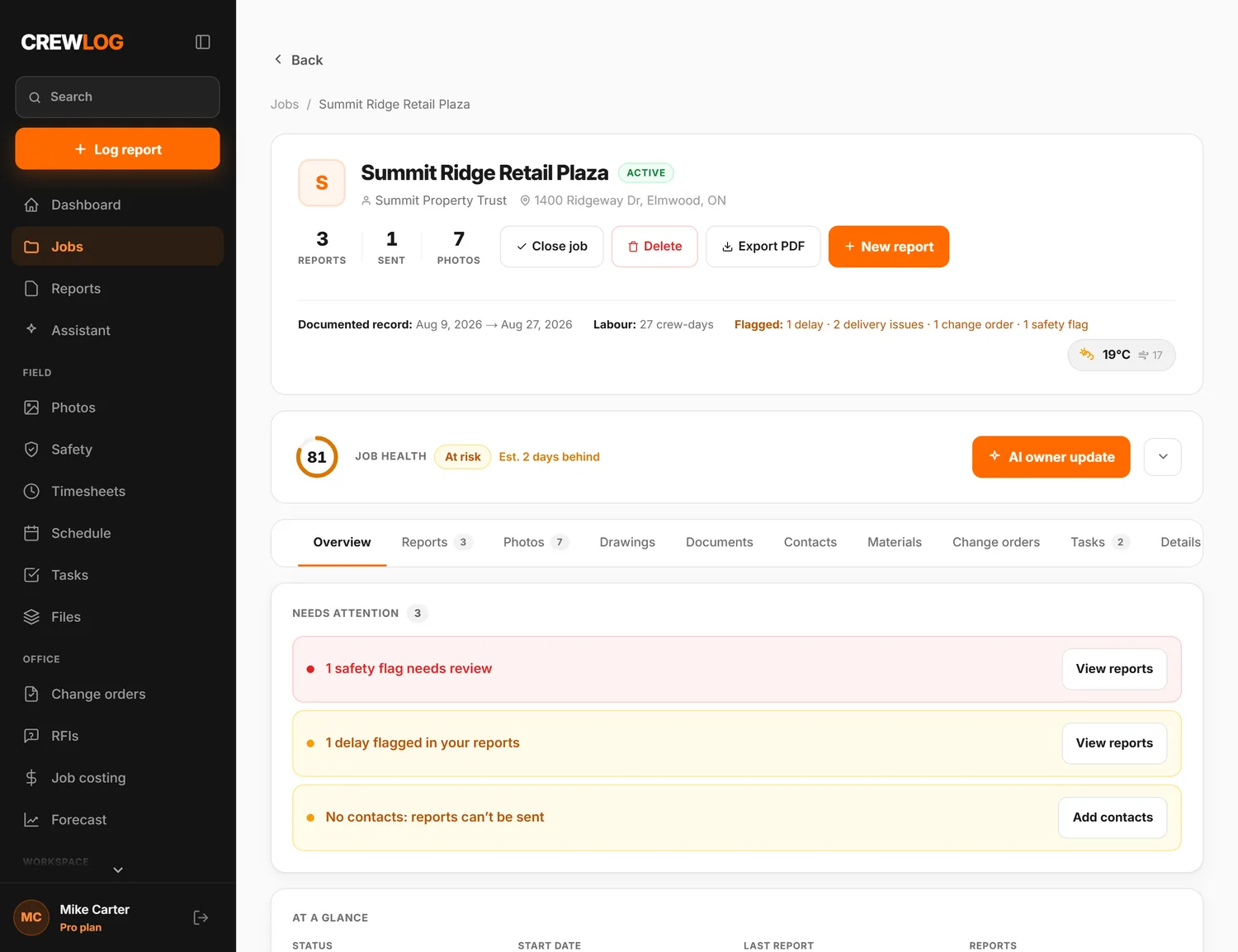
- This is the recordReports, photos, labour, flags, dates — one job
- 81, and two days behindArithmetic. The app computes it; the AI reads it out
The two days are not the model’s arithmetic. The slip is the forecast engine over your own phases and dates, and the 81 beside it is a score computed from that plus your flags, change orders and open work. The assistant reads them out and says where the two days went. Five lookups, named while they ran.
It reads across the job, but only your part of it. Every lookup is scoped to what you personally can see, not to what the account holds: a member gets the tasks assigned to them and their own hours, on any question, however it is phrased.
One box. It works out the rest.
There is no mode to pick, and there never was one. You type or you tap the mic, and it decides, silently, whether the answer needs knowledge, a look at your own data, several lookups chained together, or a change drafted for your approval. Then it shows you what it checked.
Five things people actually ask it
Pick one. Every panel is the real interface, drawn to the real spec: the same bubble, the same violet receipt, the same card. The job names and figures are illustrative; the structure and the wording are what ships.
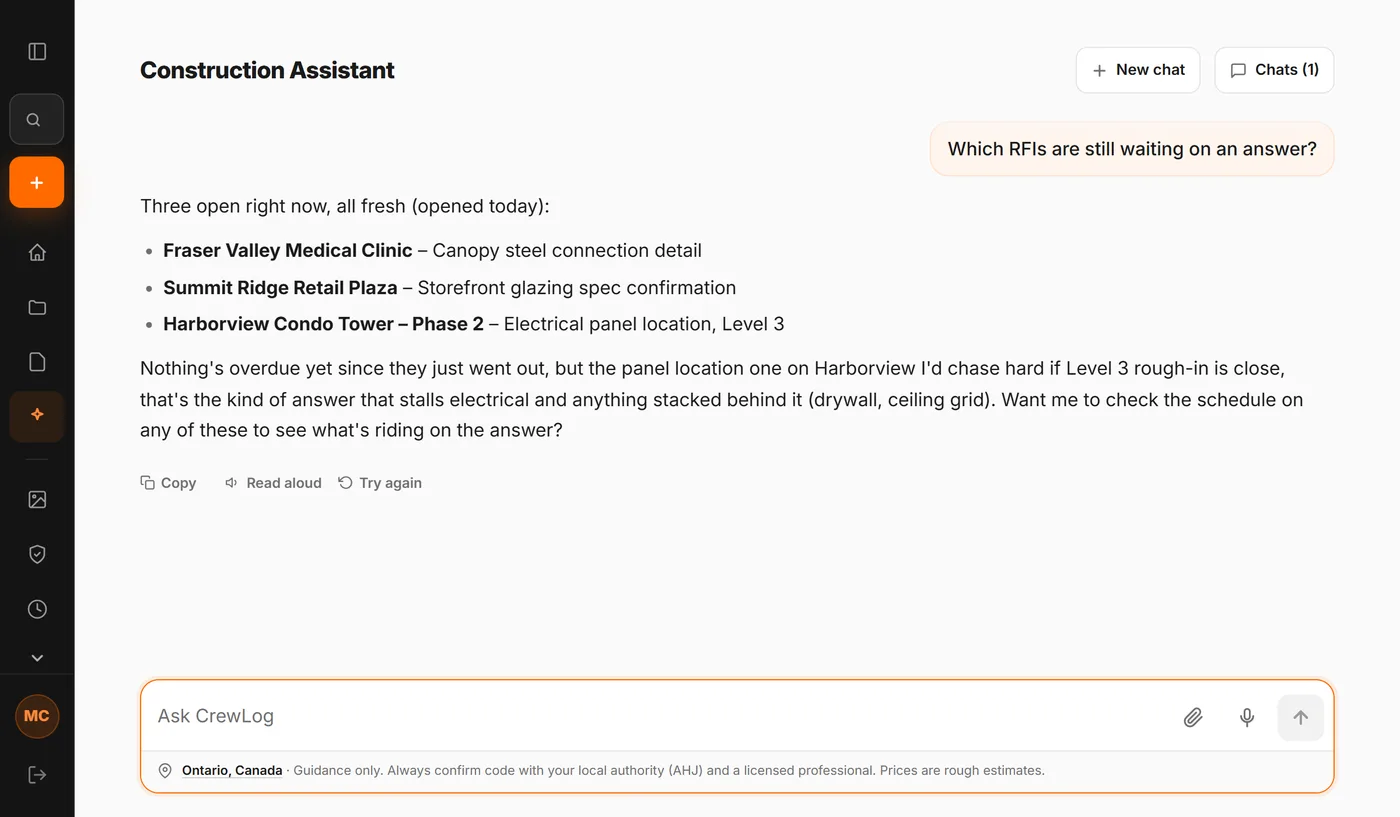
- A read answers in the turnNo card, because nothing would be written
- One box, no mode to pickTyped, spoken, or a photo of the sheet
One of these answers inside the turn. The other four stop at a card and wait. That is the whole difference between a read tool and a write tool, and it is not a setting.
After you tap
- Confirm
- The label becomes “Working…” and a separate authenticated request runs. The card then reports what happened, in your language.
- Not now
- “Dismissed. Nothing was changed.” Not tapping is a complete answer, and until you do, the card says so: “Nothing has changed yet.”
No card, because nothing was written: reads run immediately, inside the answer. Every fact in it came from a tool call scoped to what you personally can see: a member gets only the tasks assigned to them and only their own hours, on any question, however it is phrased. And “past due” is worked out in your timezone, so a foreman in Vancouver at six in the evening is not told a task is overdue when it isn’t.
Send it the sheet and ask.
Attach a PDF and it reads the sheet and the text on it — the sheet number, the detail callout, the note in the corner, the dimension you are arguing about — across every page of the set, not just the first. Ask your question in the same message.
A drawing is not a photograph of a drawing
Sent to the model as a picture, a PDF loses its text layer and every page after the first. CrewLog sends it as a document instead, so the words on the sheet stay words and page six is still page six.
It quotes the sheet, it does not summarise it
The instruction it runs under is to read the sheet before answering and to quote what it actually says. If the answer is on a sheet it was not given, it is told to name the sheet it needs rather than fill the gap.
The file is never stored
The attachment rides on that one message, goes to the model for that turn, and is not saved to your account. Only the text of the conversation is kept.
It can write anything.
It can save nothing.
Eight of its twenty-two tools draft real work — a change order, an RFI, a task, a report, a client email. Not one of them can save, send or sign a single field until you have read the card and tapped Confirm.
A write tool doesn’t write
It returns a proposal (a typed, validated description of the change) and the app draws it as a card. Only your tap runs it, as a separate authenticated request. The model can draft the work; only you can commit it.
The tool returns a proposal
A typed, validated description of the change. Nothing is inserted, updated or emailed by the tool call itself: it has no path to a table.
The app draws it as a card
With resolved values, not the model’s words: the job it matched, the person it matched, the date, the exact dollar total that would be saved.
You read the warnings
“A report already exists for this job on this date. Confirming adds a second one.” “Confirming emails this to your client straight away. It can’t be unsent.” They sit above the button, so they are read before the tap and not after it.
You tap Confirm
A separate authenticated request. Not tapping is a complete answer: “Dismissed. Nothing was changed.”
The server re-runs every check
Your plan, your role, your feature switches, the trial lock, your access to that job, and whether that person is still an active member. A hand-crafted request is exactly as constrained as the AI is.
What your client actually signs
Confirming example 03 above creates a draft. When you send it, this is what lands in your client’s inbox — your letterhead, your margin, and a total the server rebuilt from your own stored line items rather than the one the model wrote.
The limits, stated plainly
Nine of them, and not one is a hedge. A page that will not say what its AI cannot do is asking to be taken on trust by the one trade that never gives it.
- It cannot write anything without your tap. Not one field, on any table.
- It cannot send a change order. Confirming creates the draft. Sending it to your client is still your move, on your screen.
- It cannot choose who gets an owner update. That address lives on the job record.
- It cannot record a signature, ever. Attendee names on a drafted toolbox talk go on as an attendance list: a signature is a person attesting they were on site, and your crew still signs the talk themselves.
- It cannot open CAD files, spreadsheets, Word documents or links. Photos, screenshots and PDFs, one file per message.
- It cannot go and find a drawing in your library. Nothing in your account hands it a sheet — you attach the one you want read.
- It is built to look facts up, not guess them: jobs, people, dates, counts and amounts come from a lookup of your account, not from the model. It is still AI, so check anything you are about to act on.
- It does not approve anything. The AHJ, the adopted code edition and the engineer of record have the final say, and it will tell you so.
- Viewers do not get it at all, and neither does anyone you have switched it off for.
The composer, with the disclaimer built into it. The jurisdiction is a control, not a caption: tap where you work to change it.
The numbers are not generated
Job health, the safety score, the projected finish date, the critical path, the payroll: all of it is calculated by the app, deterministically, in code you could step through. The AI reads the result out. That is why an insight is instant when you drag a phase, why it costs you nothing to be told framing is late, and why you get the same answer twice.
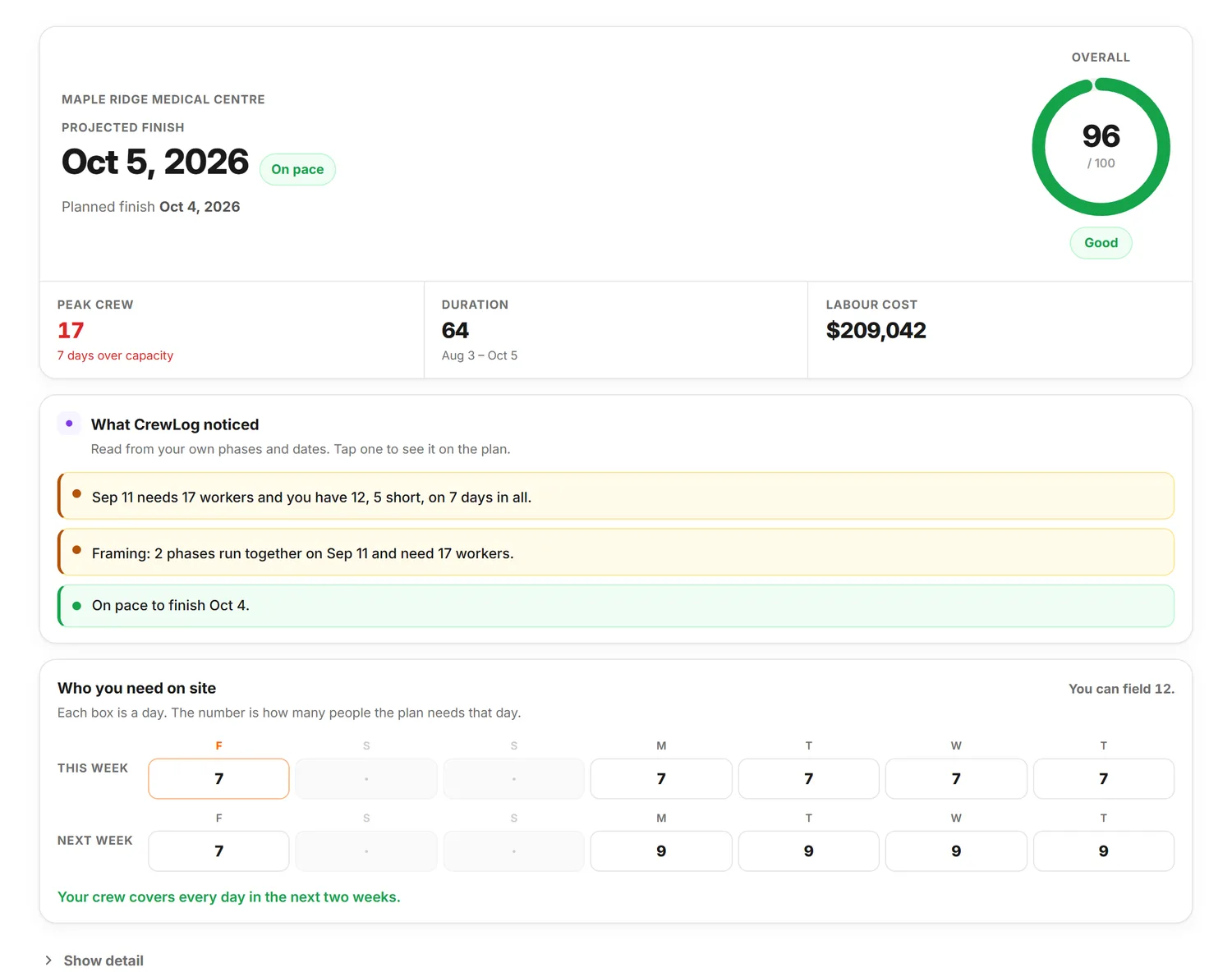
- No model produced theseProjected finish, duration and peak crew are arithmetic on your own phases
- The AI only writes the sentenceIt restates the finding — it is forbidden to compute a new date or day-count
What the app computes
The critical path, the projected finish, the slip in working days, the crew needed each day, the health score and the badge on it. Plain TypeScript over your own records with no model in the path — which is what makes it instant, free, and the same answer every time you ask.
What the model writes
The paragraph. It is handed the finished figures and told, in as many words, to use only the numbers, dates and names it was given, never to compute a new one, and never to contradict the engine. It cannot invent a delay, because it is not the thing that found one.
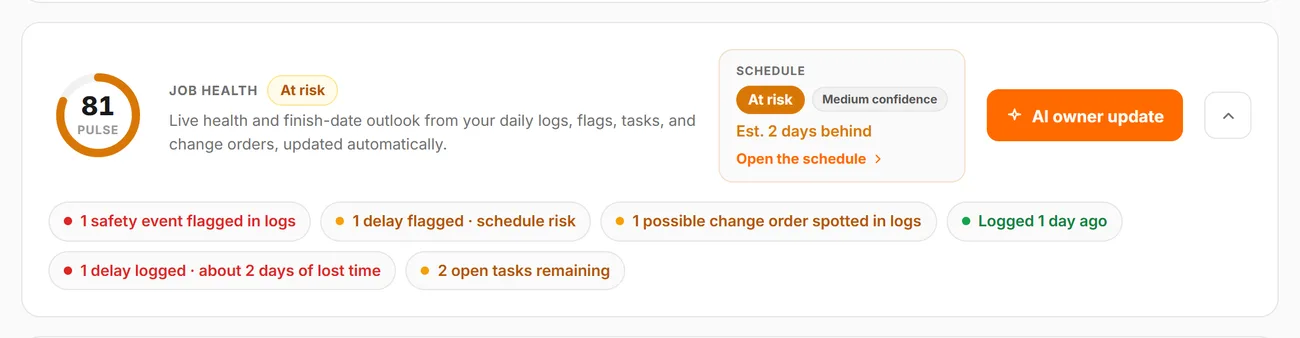
- One button, and it is the only AI hereThe 81, the badge and every chip were computed before it was pressed
What it costs, and who sees it
What it costs
The Assistant is on every plan, Solo included.
The plan changes which tools it can reach, not the box it comes in.
One monthly allowance for the whole account.
Shown as a percentage used, with the date it resets. The owner can split it across the team and top it up mid-month if a big week eats it.
Who sees it
Your content is not used to train any AI model.
We build no models, we run no training, and we do not hand your content to anyone for that purpose: that part is entirely ours to promise, and it is not a preference setting you have to go and find.
Our providers say the same, and that is their promise, not ours.
We would rather be precise than sound tougher than we are: Anthropic and OpenAI both state in the standard commercial API terms we use them under that they do not train on data sent through the API. The privacy policy puts it in exactly those terms.
The providers are named, publicly.
Anthropic (Claude) for the writing, the drafting, the briefings, receipt reading and the Assistant; OpenAI for voice transcription, and for read-aloud on iPhone and iPad. The privacy policy lists them and what each one does. The Assistant just never volunteers it mid-answer.
Everything it does, named, in one screen
Twenty-two Assistant tools — fourteen that read your account inside the answer, eight that only ever draft — and thirteen more places AI does work elsewhere in CrewLog. These are the real tool names, the exact line the trail prints while each one runs, and what each one comes back with.
Two things it does that most assistants don’t. It refuses to quote a margin it cannot stand behind: under 5% complete, no budget on the job, or costs that look incomplete for the work done, and it is handed the reason instead of the number — then has to tell you which one it was. And it refuses to report a clean safety record it couldn’t read: if the records are unavailable, it says the records were unavailable.
And thirteen more, outside the Assistant
The Assistant is one surface. AI also writes the report, pulls the flags out of it, drafts the change order and the RFI, reads your receipts, narrates the safety record and the forecast, and translates your crew’s own words for whoever is reading them.
Voice to report
A two-minute note becomes a structured daily report in about ten seconds, and it only writes the sections your notes support.
Flags and follow-ups from your notes
Delays, deliveries, possible change orders and safety events, pulled out of what the foreman said. It flags only what is clearly in the notes, and a day can produce none.
Change orders written from a description
Crew · ProYou supply the costs and the margin; it writes the document under your logo. The total on it is the one CrewLog stored, not the one the model typed.
RFIs drafted from a daily log
Crew · ProIt proposes them only where the notes show a real design conflict or missing information, and says so plainly when there is nothing there.
Receipt reading
Crew · ProPhotograph the receipt and it reads the vendor, the date, the grand total after tax, the category and the description, straight into job costing. A field it cannot read confidently comes back empty rather than guessed.
Cost briefings
Crew · ProIt narrates budget, cost to date and burn. When the job is too early to forecast a margin honestly, it is handed the reason instead of the number and has to say which one it was.
The safety read
It narrates the score and the findings on the page, and admits it: “Written from the records on this page. Check it against what you see on site.”
The Project Pulse client update
ProThe owner email, written from a health score it did not calculate. You edit it, then you send it.
The schedule outlook
ProThe slip and the status in a paragraph you can paste into an email. The instruction it runs under is to restate those numbers, never to recompute them.
Job Forecast narration
ProThe critical path and the crew clashes, explained. Every date, day-count and dollar figure in it already existed before the model was called.
Translation
Reports, notes, safety talks, tasks and photo captions are translated into whatever language each person picked. The foreman logs the day in Spanish; you read the same record in English.
Read-aloud
The finished report read out with each word highlighted as it is spoken, in the listener’s language.
Your AI usage, as a percentage
One number for the whole account, with the date it resets. Not a token count, not a credit balance, and not a surprise at the end of the month.
An unmarked row is on every plan, Solo included. Where a row carries a plan, that is the same switch the server checks before the tool is offered to the model at all. Plan by plan on the pricing page →
You still make every call.
CrewLog’s AI does not run your jobs, and it is not trying to. It takes what your crew is already saying, photographing and logging every day and turns it into the documentation the job needs. Then it stops and shows you its work, and nothing is saved, sent or signed until you say so.
7 days free on Pro, then the plan you pick · Card required, $0 today · Cancel anytime