Job costing while the job is still running
Cost labour with its burden, get receipts on the job the same day, and know your margin in time to act.
Most contractors find out what a job made after it’s over, when the last invoice is paid and somebody adds up the receipts. By then it’s too late to change anything.
Costing the job while it runs gives you the same answer weeks earlier, while there’s still time to act on it.
It comes down to three numbers: what the labour cost, what went out on materials and subs, and what the job is worth.
Start with a budget
You can’t be over budget without a budget. Before the job starts, turn your estimate into a cost plan: labour hours and dollars, materials, equipment, subcontractors and anything else.
Leave the markup out. The plan is what the job should cost you, not what you charge for it. If you won the job from a quote, take its cost lines, not its prices.
Cost labour with its burden
Labour is where job costing most often goes wrong, because people multiply the hours by the wage. The wage is only part of what an hour costs. On top of it you pay:
- Vacation pay, and paid holidays nobody works.
- Your share of payroll contributions, such as CPP and EI in Canada, or Social Security, Medicare and unemployment taxes in the United States.
- Workers’ compensation premiums.
- Benefits, and the truck, tools and training each person needs.
Add those up as a percentage of wages and you have your labour burden. Every hour on the job then costs the wage plus that percentage.
| Wage | $32.00 an hour |
|---|---|
| Burden, say 25% | $8.00 an hour |
| What an hour costs you | $40.00 an hour |
| 160 hours costed at the wage | $5,120.00 |
| The same 160 hours at true cost | $6,400.00 |
Costed at the wage, this job looks $1,280 more profitable than it is.
Your rates are your own
Payroll rates, vacation rules and workers’ comp premiums differ by province, state and trade. Take yours from your own statements, or ask your accountant.
Get every receipt onto the job the same day
Receipts are the second leak. A receipt in a truck’s cup holder is a cost the job never sees, and by the time it reaches the office nobody remembers which job it was for.
Make it a rule: a photo of every receipt, tagged to the job, the day it’s spent. Do the same with supplier invoices, and record the tax on its own line, apart from the cost.
If you use cost codes, tag those too: framing, drywall, electrical. A code on every hour and every receipt tells you which part of the job is over, not only that the job is.
Check cost against progress every week
Once a week, on the same day, look at each job: the cost to date against the budget, line by line, next to how far along the work is.
The number that matters is cost against progress. A job that has used 60% of its labour budget at 40% complete is in trouble, even though it’s still under budget.
Then forecast the finish. A simple way: divide the cost to date by the share complete. $60,000 spent at 40% complete points to about $150,000 at the finish.
If that’s more than the budget, act while the problem is small. Talk to the foreman, find the cause, and if the client changed something, price it as a change order.
Know your margin before the job ends
Your margin is the contract value, signed changes included, less what the job will cost at the finish, as a share of the contract.
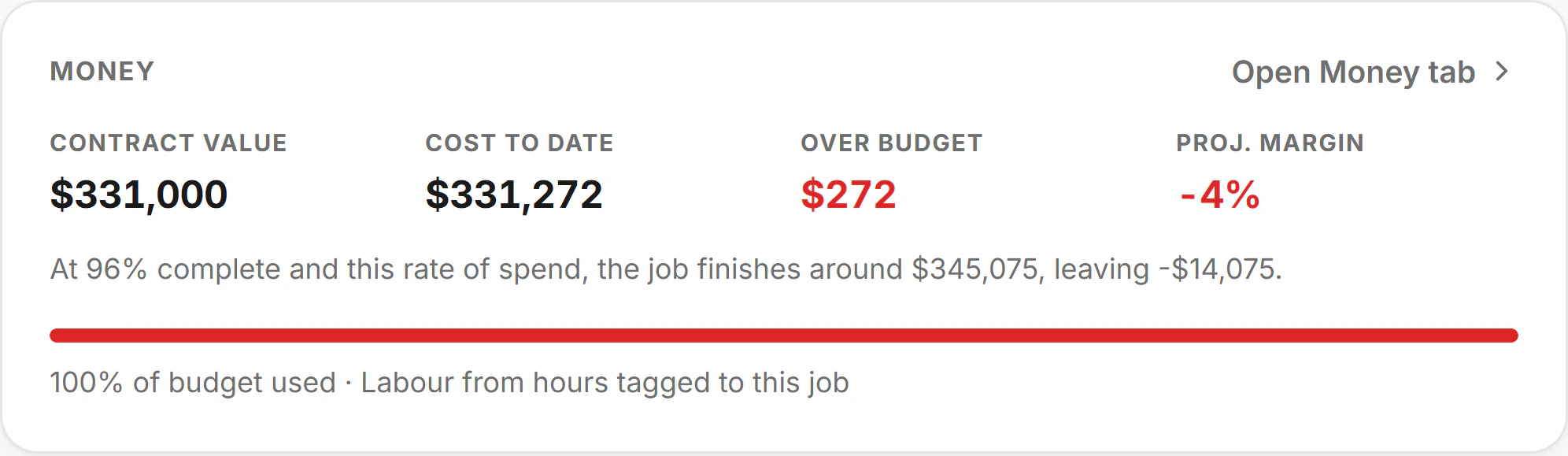
A $331,000 contract forecast to finish at $345,000 is a $14,000 loss, a margin of about minus 4%. That’s worth knowing at 60% complete, not at the final invoice.
When the job is done, compare the final cost with the estimate, line by line. That comparison is what makes your next estimate better.
How CrewLog does it
In CrewLog, hours from the time clock, receipts and signed change orders land on the job as they happen.
Each job’s Money card shows the contract, the cost to date, the projected margin and where the job will finish at its current rate of spend.

Labour is costed at wage plus burden. Tap Work it out for me, and CrewLog builds your burden from vacation pay, holidays, payroll contributions and workers’ compensation.
It starts from Ontario’s rates, for you to change. Pay doesn’t change: people are still paid their wage.
Snap a receipt on site and it goes on the job. A won quote fills in the cost plan, and with cost codes, each code’s hours, labour and receipts run against a budget of their own.
Job costing is on Crew at $89 a month and Pro at $179; cost codes are on Pro. Compare the plans.
More on job costing and cost codes on the features page.