Toolbox talks: how to run them and keep a record
A short safety talk at the start of the day, about the hazards on site that day, with a record that shows it happened.
A toolbox talk is a short safety meeting at the start of a shift, held on site, about a hazard the crew will face that day.
Done well, it takes ten minutes and catches a hazard before somebody gets hurt. Done badly, it’s a sheet read out to a crew looking at their phones.
It also leaves a record. When an inspector, a general contractor or your insurer asks how you keep your crew safe, a file of dated, signed talks is a good place to start.
Pick a topic from today’s work
The best topic is whatever is dangerous on this site today: a crane lift this afternoon, a trench going in, a new person on the crew, a heat warning. Talk about that.
Keep a list of standard topics for the days when nothing stands out:
- Fall protection, ladders and openings
- Scaffolds
- Power tools, cords and guards
- Lifting and back strain
- Heat, cold and drinking water
- Dust, fumes and respirators
- Housekeeping, slips and trips
- Working near traffic and moving equipment
Come back to the big ones often, with a new example each time. Falls, moving equipment and electrical work deserve more than one talk a year.
Run it in ten minutes
- Gather everyone where the work is. Hold it at the hazard, not in the trailer. Standing at the edge of the trench makes the point better than a handout does.
- Say what the hazard is and what it can do. Plainly, with one or two real examples, from your own jobs if you have them.
- Say what we do about it on this job. The guardrail, the harness, the spotter, the rule. Be specific to today.
- Ask, and let the crew talk. Ask the newest person what they would do. The crew often knows about a hazard the foreman missed.
- Write it down and get names. The topic, the date, how long it took, the hazards covered and who was there, each person signing for themselves.
Keep it short and keep it standing. Ten minutes people listen to is worth more than half an hour they sit through.
Make it land with the whole crew
Speak the crew’s language. If part of the crew is more at home in Spanish or French, give the talk in it, or have someone who speaks it go over the main points again.
Use your own near misses. Something that almost happened on your job last month is worth more than any example from a handout.
Let a different person lead it now and then. The carpenter who explains the ladder rule to everyone else owns that rule afterwards.
Keep a record that holds up
A talk you can’t show is, on paper, a talk that didn’t happen. A good record shows:
- The date of the talk, and when it was written down, if that was later.
- The job and the topic.
- The hazards covered and what was agreed.
- Who led it, and every person there, each signed in their own name.
- Any follow-up, like a damaged harness to replace or a guardrail to fix, with who will do it and by when.
Write it up the same day. A talk typed in a week later from memory is a weaker record, and a good record says when it was written.
Then close the loop. If the crew points out a broken guardrail, the record should show who fixed it and when.
Check the rules for your jobs
Safety law on training and records differs by province and state, and your insurer or a general contractor may ask for more. Check what applies to you.
How CrewLog does it
CrewLog comes with 32 standard talks, each with the points to cover, and you can add your company’s own, with what to say and a handout.
The foreman picks the job and the topic, notes the hazards, and everyone who was there signs on one phone by tapping their name.
Harbourview · , Wed Sep 30
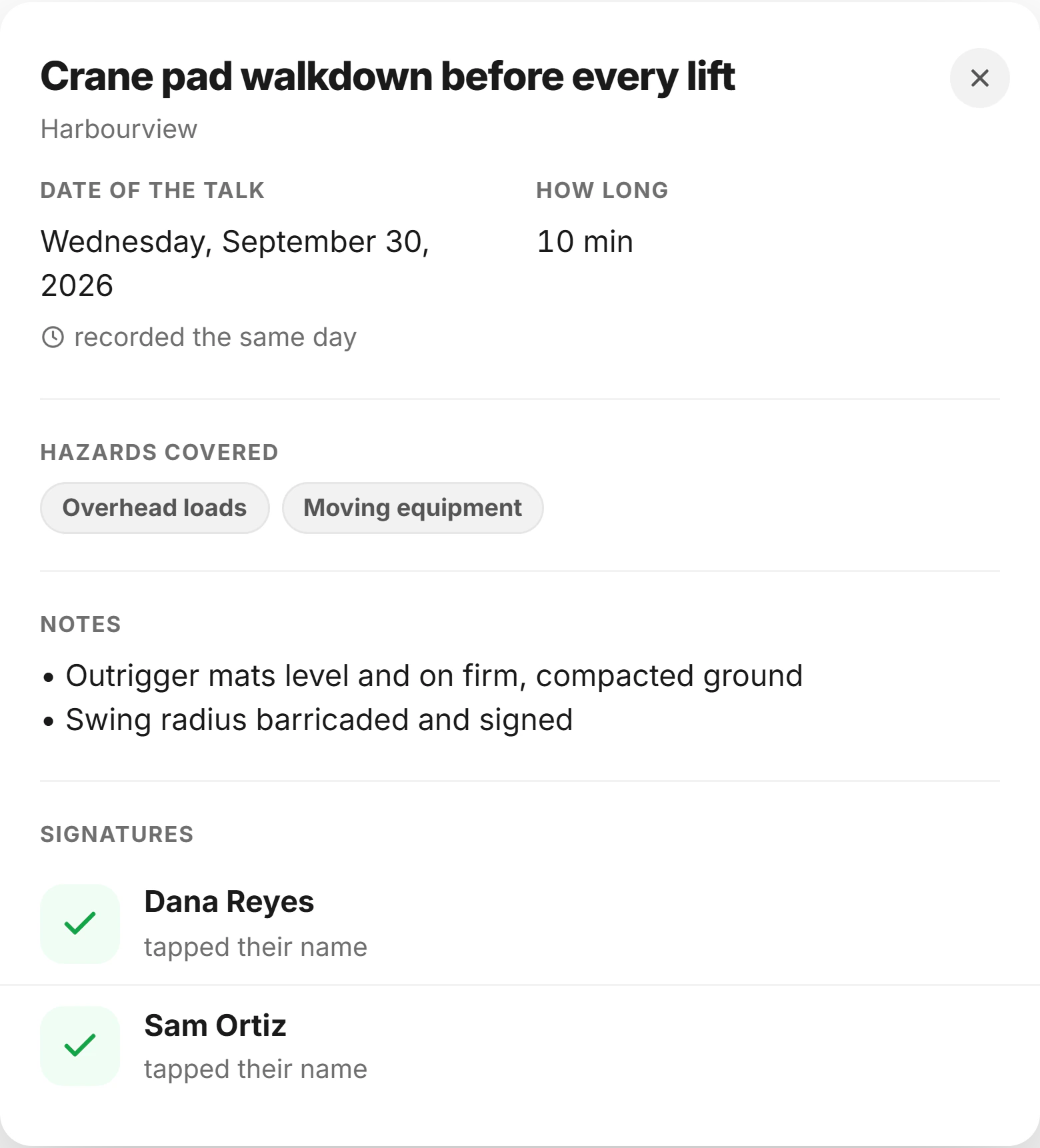

Each signature is time-stamped, and a talk entered after the day says how many days later it was recorded. A fix that comes out of a talk or an incident gets an owner and a due date.
Toolbox talks and the incident register are on every plan, from $39 a month. Each month’s talks print as one safety record PDF on Pro at $179 a month. Compare the plans.
More on safety on the features page.